Self-Advocacy Resources
A descriptive paragraph that tells clients how good you are and proves that you are the best choice that they’ve made.
Your voice is a valuable tool for change. Use it wisely!
SickleCellMN is a patient advocacy organization. We are unapologetically committed to advocating on behalf of individuals living with or impacted by sickle cell disease and sickle cell trait! Advocacy requires all of us! We cannot maximize our advocacy efforts without…
YOUR VOICE!
Using your VOICE to improve your health
Individuals living with sickle cell disease have had many healthcare experiences over the course of their lives. While many healthcare experiences can be positive, we know that is not always the case.
When healthcare goes horribly wrong, individuals and communities must demand accountability and improved care, not just for ourself, but for each and every warrior!

We also recognize that every interaction is not a negative interaction and that there are many incredible individuals working within the healthcare system who should be recognized for their expertise, empathy and compassion toward our unique individual and community needs.
Clinical Practice Guidelines & Standards of Care
A descriptive paragraph that tells clients how good you are and proves that you are the best choice that they’ve made.
Understanding Clinical Practice Guidelines and Standard of Care
GUIDELINES
Organizations with engaged employees outperform those with low employee engagement by a whopping 202%. (Source: Business2Community 2016)
STANDARD OF CARE
A standard of care is “a diagnostic and treatment process that clinicians should follow for a certain type of patient, illness, or clinical complication.” Standards of care are often referenced in malpractice suits or other legal actions wishing to show that a healthcare provider failed to provide care or performed harmful actions outside reasonable and customary established standards. A 2011 article provided this legal interpretation: “the standard of care is what a minimally competent physician in the same field would do in the same situation, with the same resources.”
Healthcare providers, especially those in large hospital systems, are often held to the standards of care in their fields. While this can be beneficial for providers with minimal knowledge of a condition or disease, it can also impact a provider’s ability to provide person-centered care and can reduce a healthcare expert’s opportunity for innovative or unique approaches based on their understanding of the person’s unique needs.
ASH Clinical Practice Guidelines for Sickle Cell Disease
In 2016, ASH brought together multiple stakeholders in the sickle cell space, including clinical experts, methodologists, and patient representatives, in order to create clinical practice guidelines on Sickle Cell Disease (SCD). The outcome became what is now known as the ASH Clinical Practice Guidelines for Sickle Cell Disease and includes treatment guidelines for:
Along with several other tools and resources, the ASH website provides clinicians with access to these resources through downloadable apps, teaching slides, podcasts, toolkits, and printed materials or “pocket guides”.
2020 National Blueprint for Sickle Cell Disease
In 2020, the National Academies of Sciences, Engineering & Medicaine, released a report entitled “Addressing Sickle Cell Disease: A Strategic Plan and Blueprint for Action.” This document is also referred to as the “NASEM Report”.
Individuals with SCD endure the psychological and physiological toll of repetitive pain as well as side effects from the pain treatments they undergo. Some adults with SCD report reluctance to use health care services, unless as a last resort, due to the racism and discrimination they face in the health care system. Additionally, many aspects of SCD are inadequately studied, understood, and addressed.
Addressing Sickle Cell Disease examines the epidemiology, health outcomes, genetic implications, and societal factors associated with SCD and sickle cell trait (SCT).
This report explores the current guidelines and best practices for the care of patients with SCD and recommends priorities for programs, policies, and research. It also discusses limitations and opportunities for developing national SCD patient registries and surveillance systems, barriers in the healthcare sector associated with SCD and SCT, and the role of patient advocacy and community engagement groups.
Medical Advocacy & Resources
There are many ways to use your VOICE to improve your health:
Complete our Patient Feedback Form
SickleCellMN works very hard to build relationships within healthcare and educational systems, and with the medical providers, educators, and leaders within those spaces.
It is important that whenever we have the opportunity to talk about the lived experiences of persons living with sickle disease, that we have real life examples of what is actually happening throughout the sickle cell community!
Complete this form and someone will contact you to further discuss on your concerns.
File a compliment or complaint through the hospital and/or clinic
All hospitals have a department dedicated to addressing patient care concerns. Here is a list of hospital systems in Minnesota. Click the link to learn more about how to address your concerns:
Allina Health Centracare Children’s MN Essentia Health Federal Medical System, Rochester Health Partners Hennepin Healthcare Mayo Hospital & Clinics M Health Fairview North Memorial Health Sanford Health
Request a correction/amendment of health information through the hospital or clinic
A Request for Amendment applies to your right to request that a hospital or clinic amend your medical record. Under HIPAA, patients have a right to request amendments to their medical records and the hospital/clinic/provider must respond to the patient’s request. A request for amendment must be in writing.
Hospitals/Clinics have the legal right to accept or deny the request, however, it is critically important that the request is submitted so that there is a “paper trail” should an institution or provider have a pattern of inaccurate reporting.
Contact your hospital or clinic’s records department to learn more about this process.
Contact the appropriate Medical Board/Board of Practice
For information related to filing a complaint about a practitioner, visit MN Department of Health’s ‘Complaints Related to to Health Care’ webpage to view phone numbers, websites and complaint forms for the following Boards:
• Board of Medical Practice
• Board of Dentistry
• Board of Chiropractic Examiners
• Board of Nursing
• Board of Pharmacy
• and more…
Join the Patient Advisory Board at your hospital or clinic
A patient advisory council, also known as a “patient advisory board” or a “patient and family advisory council,” is a representative group of patients and caregivers who meet regularly with hospital/clinic staff to help improve clinic performance.
The goal is for patients to provide their unique and invaluable perspective to hospital/clinic management, staff, and providers about how to make improvements, with the goal of better serving all clinic patients.
SickleCellMN encourages members of the sickle cell community to contact their hospital or medical team and ask about joining the Patient Advisory Board.
File a complaint with your health carrier or HMO (i.e. Health Partners, Blue Cross Blue Shield, Hennepin Health, etc.)
For information about Health Maintenance Organizations in Minnesota, please visit the list of HMO’s on the MN Department of Health website.
Are there other organizations I can reach out to share my concern(s)?
Yes, however, we advise that you first file a formal complaint through the healthcare facility’s patient affairs/complaints department as a first step. Should you remain dissatisfied after your interaction with the healthcare facility, you can reach out to us at Sickle Cell Foundation of MN as well as contact any of the following organizations.
Patient Rights and Medical Care Questions
Minnesota Board of Medical Practice 2829 University Ave. SE, Suite 400 Minneapolis, MN 55414-3246
Office of Quality and Safety Monitoring
To report a patient safety event or concern about a health care organization:
- Online: Complete online form at www.jointcommission.org
- (630) 792-5636
- The Joint Commission One Renaissance Blvd, Oakbrook Terrace, IL 60181
Office of Health Facility Complaints
P.O. Box 64970
St. Paul, MN 55101-0970
For concerns about your Medicare rights, including quality of care or premature discharge, contact:
Office of Ombudsman for Older Minnesotans
P.O. Box 64971
St. Paul, MN 55164-3591
Medicare Quality Improvement Organization (QIO)
Livanta - BFCC QIO
10820 Guilford Rd Ste 202,
Annapolis Junction, MD 20701-1262
- 1-888-524-9900
- TTY 1-888-985-8775
Education Resources for Warriors & Caregivers
Whether you (or your child) is just beginning your education journey or you (your child) are headed off to college, it can feel like an exciting, yet worrysome time. We know that this can be difficult, especially if you’ve been the primary caregiver and advocate concerning sickle cell disease.
An Overview of Laws & Guidance
Elementary and Secondary Education Act of 1965 (ESEA), as amended
• Every Student Succeeds Act (ESSA) Information page
• ESEA Flexibility: Information about flexibility from certain No Child Left Behind requirements that ED is offering to states.
• Text of the Elementary and Secondary Education Act of 1965, as amended by ESSA and the National Defense Authorization Act, 2017: Introductory materials — Title I — Title II — Title III — Title IV — Title V — Title VI — Title VII — Title VIII
• Text of No Child Left Behind Act: For certain ESEA programs, the requirements of NCLB apply through the 2016-2017 school year.
Civil Rights Provisions
• Disability Discrimination (Title II of the Americans with Disabilities Act)
Section 504 FAQ
Sex Discrimination (Title IX of the Education Amendments of 1972)
Race and National Origin Discrimination (Title VI of the Civil Rights Act of 1964)
*Information used in this section was adapted from various online sources, including the U.S. Department of Education, Howard Law School and the UC Santa Cruz DRC
Employment Resources for Warriors & Caregivers
Your Rights as an Employee living with or caring for a family member with SCD
For many adults living with sickle cell disease, finding and keeping a job can be a challenging experience. Persons with sickle cell disease often miss work due to challenges related to medical appointments, complications related to pain and chronic fatigue, and the many other issues that impact quality of life for Warriors.
Most employers, management and co-workers do not understand the complexities of living with a chronic condition, especially sickle cell disease! This lack of awareness often causes others to make incorrect and unfair assumptions that lead to biases and judgements. The good news is that there are FEDERAL LAWS that protect job applicants and employees with SCD!
Two main laws cover work-leave
Americans with Disabilities Act (ADA)
The Americans with Disabilities Act (ADA) is the Bill of Rights for individuals with disabilities and includes 2 major provisions:
- prohibits discrimination against people with disabilities in many areas, including employment.
- It protects employees during application, hiring, promotion, compensation, and training.
The law requires employers to provide “reasonable accommodations” for applicants and employees with disabilities. The specific accommodations fall into 3 categories:
- Changes to the application process
- Modification of the physical work environment or how a job is performed
- Enabling equal access to benefits of employment (cafeterias, lounges, etc.)
The ADA also makes it illegal for employers to ask applicants about whether they have a disability or how severe it is. Also, employers must keep any medical information confidential, including requests for reasonable accommodations.
In Minnesota
The Minnesota Human Rights Act (MHRA) also protects people with disabilities. Most of the differences between it and the ADA are minor. One big difference is that the ADA only covers employers with 15 or more employees, while the MHRA covers all employers, no matter how small the business. The Minnesota Department of Human Rights (MDHR) is the state agency that enforces the MHRA.
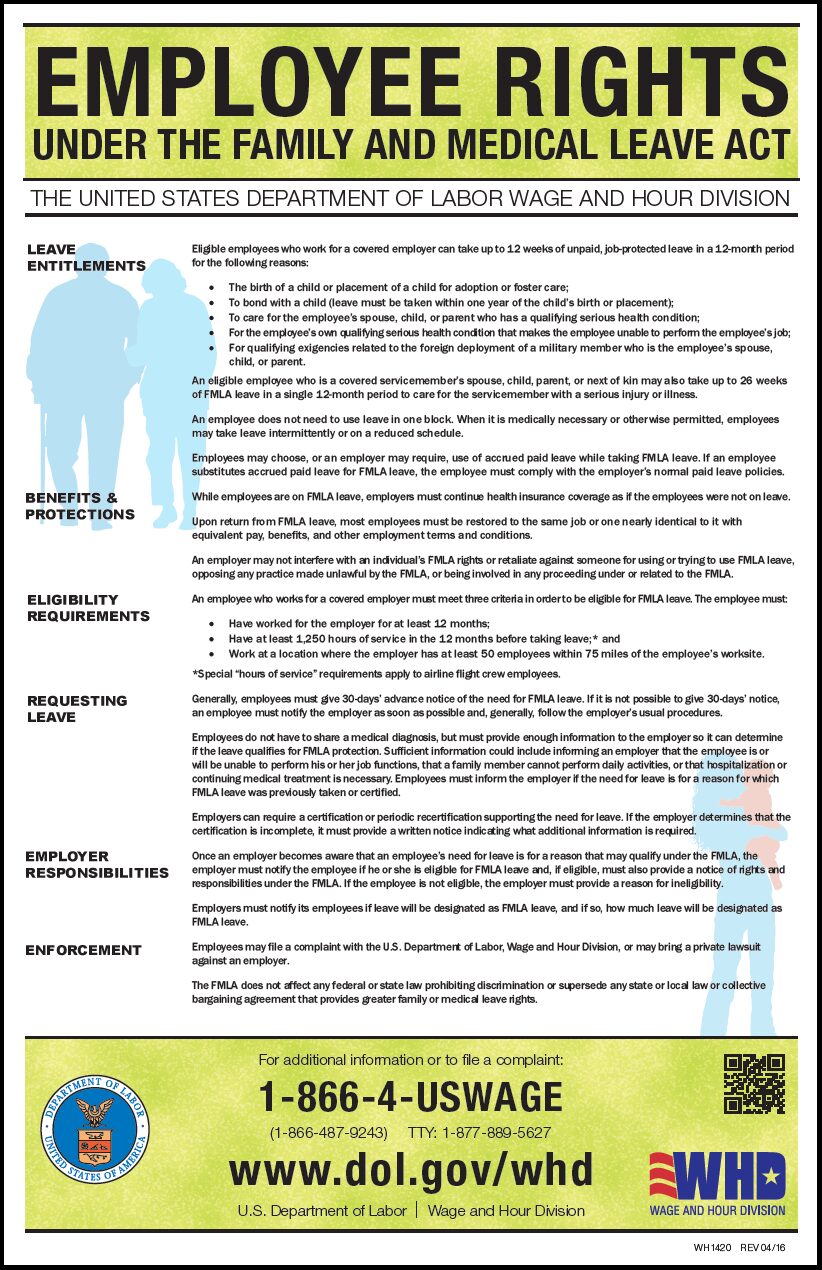
Family and Medical Leave Act (FMLA)
The FMLA allows eligible employees to take up to 12 weeks off per year for family or medical reasons. One qualifying reason to use this is for a serious health condition that makes you unable to work. The time can be taken off: 6-9
- All at once, like for maternity leave or after a major surgery
- In separate blocks of time for a single reason
- In a way that reduces your weekly or daily schedule
Serious health conditions most commonly require time off through FMLA when:
- You need an overnight stay in a hospital
- You are unable to work for more than 3 days
- You have periods of disability and treatment
What if my employee rights have been violated?
If your employee rights have been violated, there are certain steps you can take to address the issue.
1.Start by documenting the details of the incident, including the date, time, and any witnesses.
2. Review your employee handbook and company policies to determine if the violation was in breach of any established rules. (There are experienced employment lawyers who can advise you on your legal rights and next steps)
3. Consider filing a complaint with the appropriate government agency, such as the Minnesota Board of Labor or Equal Employment Opportunity Commission (EEOC).
4. Consider filing an ADA discrimination complaint.
It’s important to act promptly, as there may be time limitations for bringing a claim. Remember, standing up for your employee rights not only helps you, but can also benefit others who may be facing similar violations in the workplace.
What if I cannot work anymore?
If SCD prevents you from working, you may be eligible to receive Social Security Disability Insurance (SSDI). This program pays monthly benefits if specific requirements are met. Having SCD does not automatically make you eligible.
During the SSDI application process, you will provide documentation of your SCD diagnosis. They will look at your medical records to determine if you are eligible. Some factors that may make you eligible include:
• Painful crises requiring injected or IV opioids at least 6 times within the last year
• Complications of anemia requiring at least 3 hospital stays within the last year
• Low hemoglobin measurements at least 3 times within the last year
Even if you do not meet these requirements, you may still qualify for disability benefits. Talk to your doctor for help putting together your application.
*It is important to regularly visit your doctor and undergo treatments. Without regular visits, they may not consider your condition severe enough for SSDI benefits.
More Self-Advocacy Resources
Tips for Self-Advocacy in the clinic, school or work setting
Lorem ipsum dolor sit amet, consectetur adipiscing elit. Ut elit tellus, luctus nec ullamcorper mattis, pulvinar dapibus leo.
*Information in this section was adapted from the UC Santa Cruz DRC
/01
Be Self-Aware
In order to advocate for yourself, you need to know yourself, including your medical condition(s). Practice your ability to clearly describe your medical condition(s) and the way it impacts your quality of life. This involves knowing your strengths and your weaknesses.
/02
Know Your Needs (and your medical plan)
With a clear understanding of your sickle cell, you can assess types of accommodations you may need in order to obtain equal access to your healthcare, education or career goals. The better you know how your sickle cell affects you, the more effective you can be in determining what assistance you may need. Evaluate your medical plan, school, or work accommodations that you have received in the past, learn about different types of assistance and/or accommodations that are available to you, and assess areas in which you are having difficulty medically, academically or in your work environment.
/03
Practice Assertiveness
Being assertive does not mean aggressively making demands. It does mean knowing your rights and vocalizing your needs. It involves taking responsibility for your health and personal goals and not expecting others to problem solve or make decisions for you.
/04
Develop Self-Confidence
One of the things that can prevent a warrior or caregiver from being a strong self-advocate is shame regarding your diagnosis. This causes a person to hide their diagnosis and avoid asking for assistance that is needed. Studying about the disability civil rights movement, learning about disability from a diversity or cultural perspective, finding peer support among others with similar challenges and learning to value the strengths you have developed as a result of your diagnosis can all assist you in gaining self-confidence. Having sickle cell is nothing to be ashamed of, neither is requesting accommodations that allow you to have equal access to your education.
/05
Utilize Support
“A person who self-advocates should not feel alone. Good self-advocates know how to ask questions and get help from other people”. Residents of Minnesota: If you have additional questions or concerns, please contact us.
Other Self-Advocacy Resources & Links
Employer Accommodations
You are not required to tell an employer you have SCD when you apply for a job! However, it is important but often difficult to know when to inform them of your diagnosis.
An informed employer can provide reasonable accommodations during the interview process. However, many people with SCD find that a good time to ask for reasonable accommodations is once you receive a written job offer.
You may want to consider creating a personalized accommodations/support plan with your employer. The plan should cover:
• Preventive measures to keep you healthy at work
• Reasonable accommodations to your work environment and schedule
• When to get emergency help
• Who to contact in case of an emergency
• Some accommodations you may want to discuss with your employer include:
• A guaranteed parking space near the building
• Considerations for working flexible hours or working from home
• Ensuring access to adequate water and bathroom breaks
• Explore hospital and medical appointments as paid time off
• Adjusting policies for sickness absences
• Allowing working from home
• Modifying uniforms to enable warm and comfortable clothing
• Making sure deadlines are flexible to minimize stress
• Ensuring the workplace is warm by adjusting the temperature, providing heaters, or placing your workstation in the warmest area
MN Department of Labor & Industry
The Department of Labor and Industry (DLI) ensures Minnesota’s work and living environments are equitable, healthy and safe. The agency oversees the state’s programs for apprenticeship, construction codes and licensing, dual-training pipeline, occupational safety and health, wage and hour standards, workers’ compensation and youth skills training programs.
Helpful Links:
MN Attorney General
The Minnesota Attorney General’s Office appreciates hearing from members of the public. In many cases, we are able to provide direct assistance to people. Hearing from members of the public also alerts us to problems occurring in the marketplace.
Helpful Links:
RARE Disease Advocacy
In Minnesota, the Rare Disease Advisory Council (RDAC) is an executive branch, non-cabinet agency tasked with advocating for improved care for the 1 in 10 Minnesotans living with a rare disease.
The council is a cross-sector and geographically diverse group of governor-appointed council members and staff.
RDAC’s primary stakeholders are the Governor, Legislature, state agencies, rare disease patient organizations, and, foremost, citizens.
RDAC’s mission is to provide advice on research, diagnosis, treatment, and education related to rare diseases.
Council duties include developing educational resources, identifying best practices for rare disease care, advising state agencies, and identifying barriers to care.
*NOTE: Rae Blaylark, President and CEO of SickleCellMN sits on this Council and is a member of the Policy Sub Committee.
For more information about the MN RDAC, visit their website, email info@mnraredisease.org or call 651-706-1960.
Helpful Links:
MN Rare Disease Advisory Council:
• RDAC Staff & Council Members
National RARE Organizations & Efforts:
• EveryLife Foundation for Rare Diseases
• National Organization for Rare Disorders (NORD)
• NIH/GARD National Institute of Health (NIH) and Genetic and Rare Diseases Information Center (GARD)
Financial Support:
Employment Resources
Many initiatives, such as those listed below, help people with disabilities connect to potential employers.
• Workforce Recruitment Program for College Students with Disabilities (WRP)
• Office of Disability Employment Policy
• Campaign for Disability Employment
*Note that some programs are agencies within the U.S. Department of Labor.
MN Department of Human Rights
MN Department of Human Rights (MDHR) is the state’s civil rights enforcement agency. This Department protects the civil rights of Minnesotans through the Minnesota Human Rights Act, one of the strongest civil rights laws in the country.
Helpful Links:
• Civil Rights Fact Sheet (pdf)
MN Council on Disability
The Minnesota Council on Disability (MCD) was established in 1973 to advise the Governor, state agencies, the state legislature, and the public on disability issues. Our vision is a barrier-free Minnesota where every person with a disability has full access to all areas of life. This vision of the MCD is guided by the principles of accessibility, equity, and independence.
The MCD also provides:
• Public Policy Advice
• Technical Assistance
• Training and Outreach
Nothing changes until WE make our experiences known and OUR voices heard!
We know that there are both good and bad experiences within the healthcare system. Whenever there is a pattern of inequity within our community, we must unify our voices and demand accountability and improved care for all warriors! We also recognize that every encounter is not a negative one and that there are many incredible individuals working within the healthcare system who should be recognized for their expertise, empathy and compassion toward our unique individual and community needs.
SickleCellMN has developed a reporting system to track the feedback that we receive from our sickle cell community, but we need you to use your voice! Help us track and report your healthcare experiences by completing the warrior experience form.
Our Voices Matter!
Why share positive experiences?
• All feedback is important and by sharing your positive experiences we can:
• Provide this feedback to schools, teachers, hospitals and providers who are making improvements
• Provide recommendations and feedback to others who are looking for knowledgeable and compassionate care in Minnesota
Why share negative experiences?
• Sharing you or your loved one’s negative experience(s) allows us to better advocate for the sickle cell community by providing accurate accounts of personal LIVED experiences of persons living right here in Minnesota!
• Sharing your negative experiences with us allows the community to have a safe space to report your experiences without worrying about how it may or may not negatively impact you or your child’s care.
How do we use the information provided?
1. Community advocacy & storytelling
2. Internal tracking & reporting
3. Identifying sickle cell champions within healthcare settings
4. Institutional accountability (filing formal complaints)
5. Legislative efforts
Community Advisory Board
Sickle Cell Foundation of MN focuses it’s efforts on Patient and Community Advocacy. In order to effectively represent the community, we rely on individuals impacted by SCD to inform our work and provide feedback that assists us with our strategic goals.
Use your voice for good!
Join our Community Advisory Board to assist us in our efforts to ensure that our organization is fulfilling our mission to improve quality of life for individuals and communities impacted by sickle cell disease and sickle cell trait.